
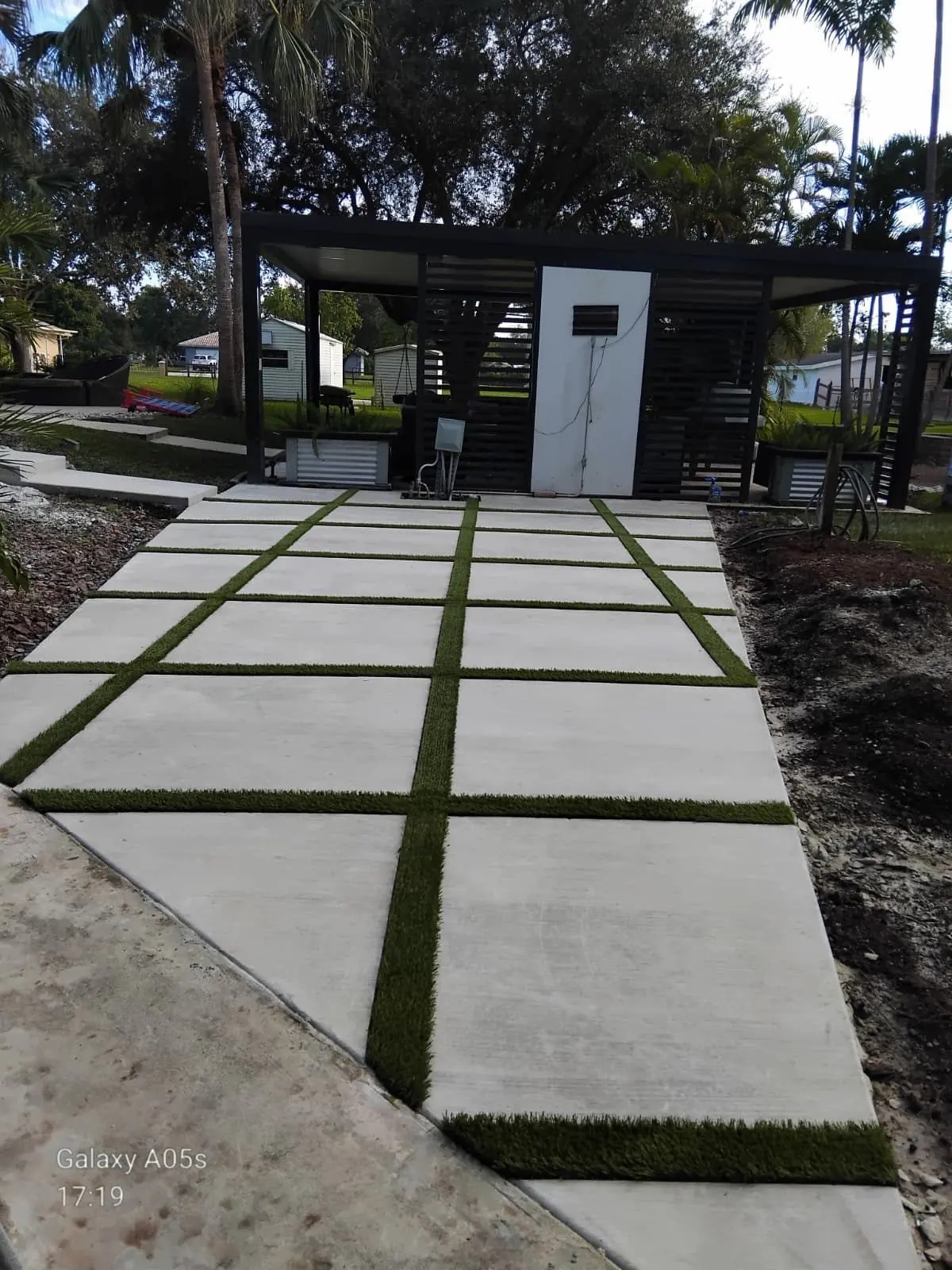
Pervious vs. impervious, in plain terms
Impervious surfaces keep rain from soaking into the ground: roofs, concrete, asphalt, pavers set on a concrete base, and pool decks. Many cities count the pool too. Pervious surfaces let water through, like grass, planting beds and, in some cities, approved permeable pavers.
South Florida cities limit impervious area to control flooding. Every square foot of new driveway, patio or roof counts against your lot’s limit, so the first question on any project in Cooper City is how much allowance you have left.
Coverage, the 35% rear-yard cap and turf credit
Cooper City allows up to 2 accessory buildings, together covering no more than 35% of the rear yard, and they count toward building coverage (Cooper City code). Maximum building coverage is set by zoning district in Sec. 23-14 (Cooper City Sec. 23-14).
For artificial turf, Ordinance 23-14 gave turf an 80% credit in impervious calculations and requires 3 ft of pervious area between the turf and the side and rear lines (Cooper City Ordinance 23-14).
Driveway setbacks in Cooper City
- Driveways: at least 12 ft wide, 6 ft from private property lines and buildings, and 10 ft from the public right-of-way (Cooper City §25-5).
- Single-family homes need 3 off-street parking spaces.
Pergolas, gazebos and new structures
- Gazebos and pergolas: up to 14 ft tall and 230 sq ft.
- Sheds, chickee huts, gazebos and pergolas can sit in side or rear setbacks if they are at least 6 ft from the property line, or 3 ft with a 6 ft privacy fence and any easement releases.
- No more than 2 accessory buildings, together covering at most 35% of the rear yard.
Artificial turf and pavers
Under Ordinance 23-14, 80% of a turf area counts as pervious, so 500 sq ft of turf counts as 100 sq ft of impervious area. Leave 3 ft of real pervious area between the turf and the side and rear lines.
Statewide, Florida now requires DEP standards for synthetic turf on single-family lots of 1 acre or less, and local governments can’t prohibit turf that meets them (Florida Statutes §125.572). The DEP rule took effect May 19, 2026 (Davie staff report). Cities can still regulate drainage, so how turf counts on your impervious calculation is still the city’s call.
A quick example
The 230 sq ft pergola cap is firm. A 15 by 15 ft pergola (225 sq ft) fits, but a 16 by 16 ft one (256 sq ft) does not. If your rear yard is 70 by 25 ft (1,750 sq ft), all accessory buildings together can cover up to 612 sq ft.
Your numbers will be different. The Cooper City lot simulator runs the same math for your lot.
See how much you can add
Enter your lot size, what’s already built, and the driveway, pergola or structure you want. The simulator checks your impervious percentage, coverage and setbacks against the Cooper City rules above and shows the largest size that still fits.
Open the Cooper City lot simulator →
The simulator gives a planning estimate, not a permit approval. Rules vary by zoning district, subdivision and HOA. This guide reflects published code as of October 2026, and we confirm the current version and your survey before every submittal. Source: Cooper City Code.
We’re a State of Florida Certified General Contractor (CGC1527850). See our Cooper City service area or Pergolas and outdoor living.
Frequently asked questions
How big can a pergola be in Cooper City?
Up to 230 sq ft and 14 ft tall.
How close can a pergola be to my fence?
At least 6 ft from the property line, or 3 ft if there is a 6 ft privacy fence and any easement releases are in hand.
Does turf count as impervious in Cooper City?
Partly. Turf gets an 80% pervious credit, so only 20% of its area counts as impervious.