
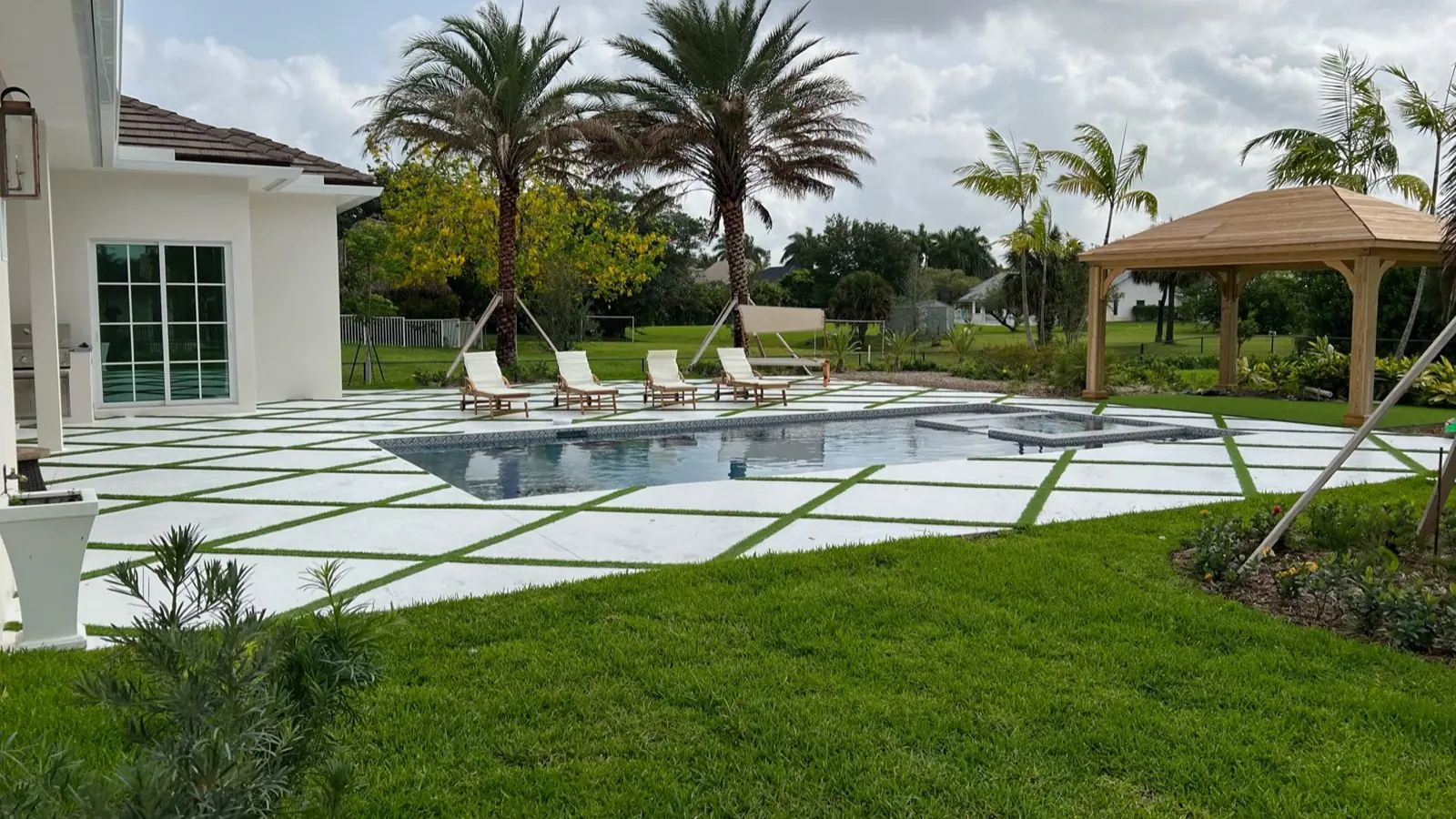
Pervious vs. impervious, in plain terms
Impervious surfaces keep rain from soaking into the ground: roofs, concrete, asphalt, pavers set on a concrete base, and pool decks. Many cities count the pool too. Pervious surfaces let water through, like grass, planting beds and, in some cities, approved permeable pavers.
South Florida cities limit impervious area to control flooding. Every square foot of new driveway, patio or roof counts against your lot’s limit, so the first question on any project in Fort Lauderdale is how much allowance you have left.
Pervious area and the 35% rear-yard cap
Fort Lauderdale defines pervious area as uncompacted ground, open to the sky, that lets air and water reach the soil. Inside required landscape areas, hard surfaces like borders, sidewalks and step stones can’t go over 10% (ULDR Sec. 47-21).
At-grade patios and other hard surfaces can go in required yards if they sit no higher than the lowest finished floor, but they still count against the pervious-area requirement. Accessory buildings together can’t cover more than 35% of the rear yard (ULDR Sec. 47-19). Some neighborhoods have their own limits. In the Melrose Park and Riverland Road areas, for example, plot coverage is capped at 40%.
Driveway setbacks in Fort Lauderdale
- Driveways are allowed in front, corner and side yards, and in rear yards that back onto a street or alley.
- A driveway used for parking must be at least 18 ft long from the property line.
- On waterfront lots, yards are measured from the wet face of the seawall.
Pergolas, gazebos and new structures
- Accessory buildings combined: no more than 35% of the rear yard.
- An open-weave entry trellis can go in the front yard if it is no more than 11 ft high, 8 ft wide, 4 ft deep and 50% opaque.
Artificial turf and pavers
Ask the City how it will count your turf system against pervious area. Its code defines pervious area as uncompacted ground, and turf is usually laid over a compacted base. State law now limits how cities restrict compliant turf on lots of 1 acre or less.
Statewide, Florida now requires DEP standards for synthetic turf on single-family lots of 1 acre or less, and local governments can’t prohibit turf that meets them (Florida Statutes §125.572). The DEP rule took effect May 19, 2026 (Davie staff report). Cities can still regulate drainage, so how turf counts on your impervious calculation is still the city’s call.
A quick example
If your rear yard is 60 ft wide and 25 ft deep (1,500 sq ft), all accessory buildings together, such as a gazebo, cabana and shed, can cover up to 525 sq ft.
Your numbers will be different. The Fort Lauderdale lot simulator runs the same math for your lot.
See how much you can add
Enter your lot size, what’s already built, and the driveway, pergola or structure you want. The simulator checks your impervious percentage, coverage and setbacks against the Fort Lauderdale rules above and shows the largest size that still fits.
Open the Fort Lauderdale lot simulator →
The simulator gives a planning estimate, not a permit approval. Rules vary by zoning district, subdivision and HOA. This guide reflects published code as of October 2026, and we confirm the current version and your survey before every submittal. Source: Fort Lauderdale ULDR.
We’re a State of Florida Certified General Contractor (CGC1527850). See our Fort Lauderdale service area or Gazebos and cabanas.
Frequently asked questions
How big can a gazebo be in my Fort Lauderdale backyard?
All accessory buildings together can cover up to 35% of the rear yard.
Do patios count against pervious area?
Yes. At-grade patios are allowed in yards, but they still count against the pervious-area requirement.
How are setbacks measured on waterfront lots?
From the wet face of the seawall, or the edge of the water where there is no seawall.