
What the design actually is
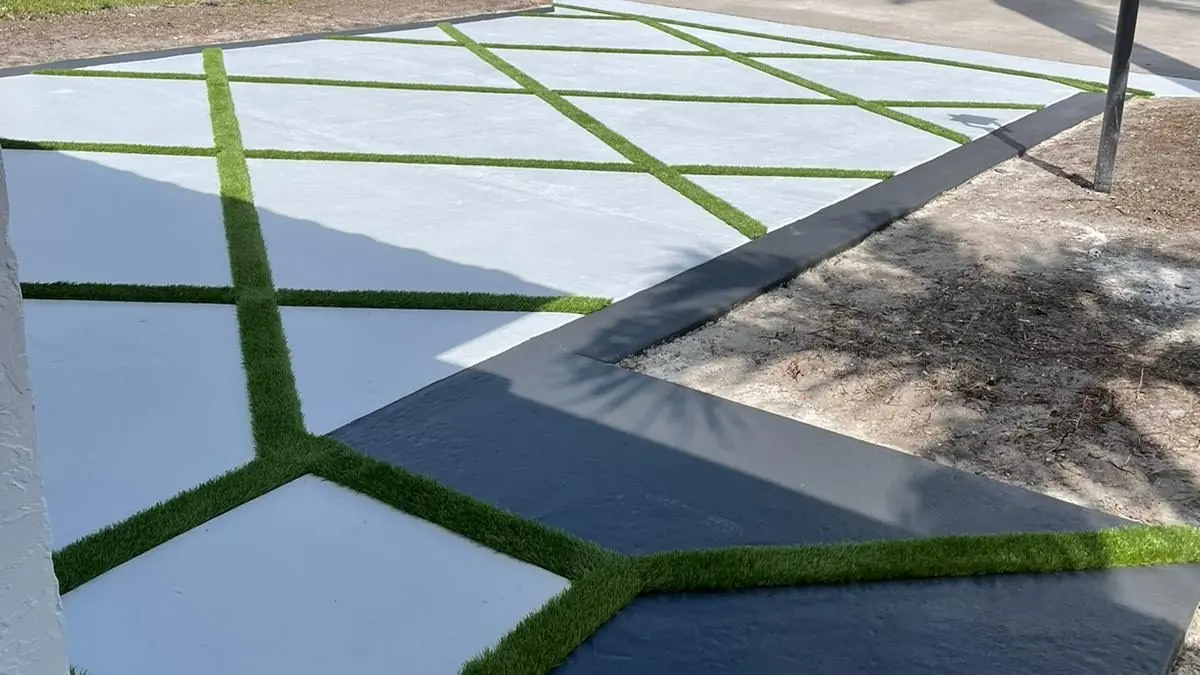
The idea is simple: the driveway, patio or pool deck is built as a series of large concrete panels, and the gaps between them are finished with artificial grass instead of solid concrete. The panels can sit in a straight grid, a running bond, an offset pattern, or a diagonal. The turf can be a narrow line that reads as a joint, or a larger rectangle that reads as a surface of its own.
Both versions are modern for the same reason: the eye sees fewer, larger pieces and a repeated rhythm. At a Weston home we used 8' x 16' turf rectangles across a 7,600+ sq ft driveway, because thin strips would have disappeared at that scale. On a smaller front yard, narrower joints usually look more refined. See more of both on our concrete and artificial grass page.
Start with the house, not a pattern
The best layouts borrow lines that already exist. The panels should line up with the garage door, the front entry, columns, windows or the edge of the pool, so the pattern leads toward the house instead of fighting it. A pattern copied from a photo of another home often looks forced when the proportions and the approach are different.
Circulation comes first. Cars need room to turn, guests need an obvious path to the door, and a circular drive needs clear entry and exit points before any geometry is drawn. Narrow or irregular lots often look better with long linear bands than with a full grid. Our modern concrete driveway planning guide goes deeper into proportions and joint planning.
What sits under the surface
The concrete panels carry the cars. The turf joints don’t, so each joint needs its own drained, compacted base, set so the turf finishes level with the concrete and stays that way. When the two are built by separate crews with no shared plan, that is usually where uneven gaps and mismatched heights come from.
Joint width and panel size are decided before the forms go in. Changing them later means cutting panels or rebuilding the base. The panel layout also has to respect how concrete moves as it cures and as the weather changes, so the joints that make the pattern and the joints the slab needs should be the same lines, drawn on purpose.
Drainage, impervious limits and the 2026 turf rule
Turf joints help water move, but they don’t replace grading. The surface still needs a consistent fall away from the house and garage and toward the swale or another approved outlet, and the turf base has to drain instead of holding water against the concrete.
Most cities also cap how much of a lot can be impervious, and how a turf joint counts toward that total is up to the city reviewer. We show joint areas separately on the calculation and confirm before we pour. Our city guides for Davie, Weston, Parkland, Boca Raton and other cities explain the local limits, and the free lot simulator shows how much room you have.
Turf itself is regulated too. Since May 19, 2026, Florida Rule 62-308.100 sets minimum standards for synthetic turf on single-family lots of 1 acre or less, and section 125.572, Florida Statutes, limits how cities can restrict turf that meets them. Cities can still regulate drainage, and the state standards keep turf out of swales, ditches and stormwater areas. Local codes are still catching up, so we confirm the current rules with the city before every job.
Permits and HOA approval by city
Every city handles this a little differently. Weston communities often have HOA design guidelines that need approval first. Parkland has its own synthetic turf permit and base inspections. Wilton Manors requires a building permit for all synthetic turf. In Davie, the rules depend on lot size, because acreage properties may still fall under the Town’s own turf limits. Fort Lauderdale applications go through LauderBuild, and in Boca Raton turf stays out of the City right-of-way.
Our city pages cover each one: artificial turf in Davie, Weston, Parkland, Plantation, Coral Springs, Fort Lauderdale, Wilton Manors and Boca Raton.
Can you add turf to existing concrete?
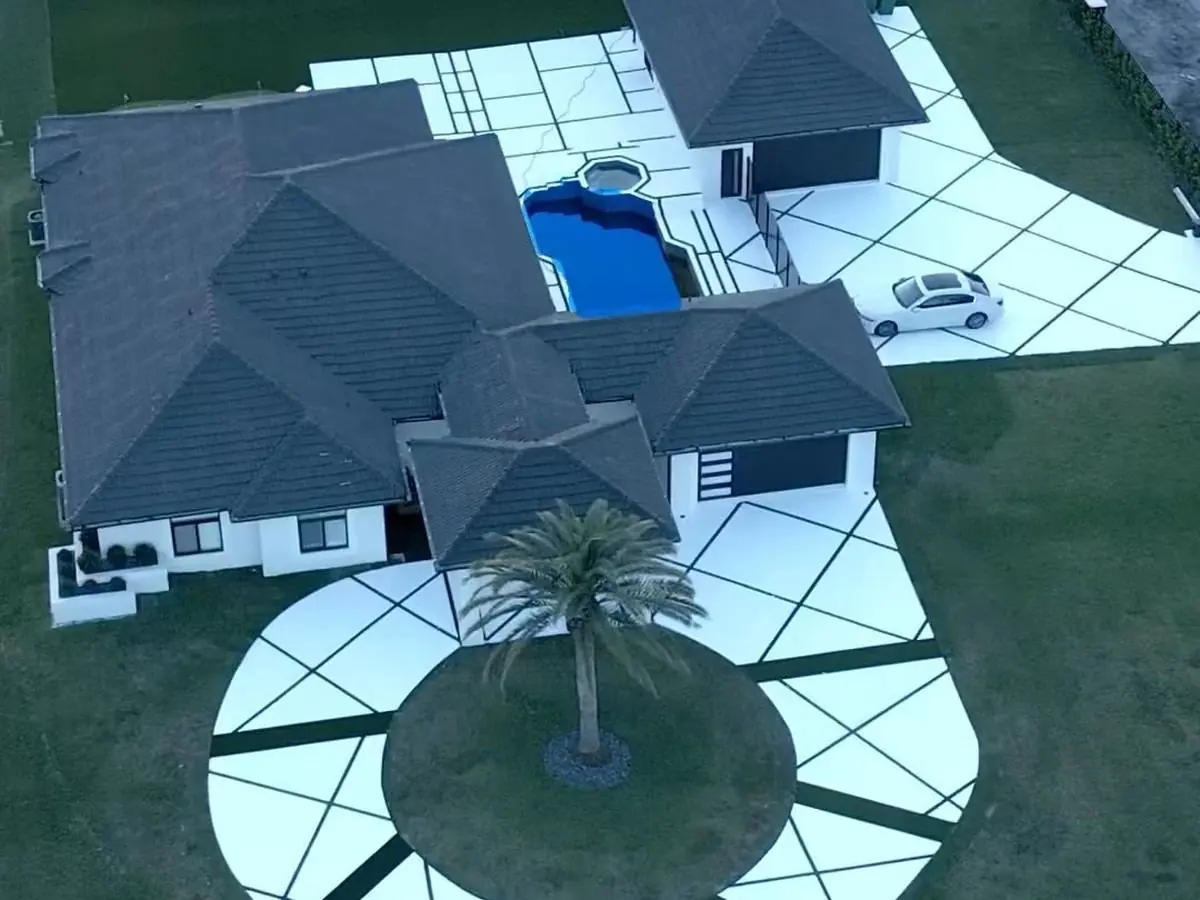
Sometimes. A saw-cut or resurfacing design can work when the existing slab is sound, but it depends on the slab’s condition, its elevations, drainage, existing cracks and the pattern you want. At one Davie property we turned cracked concrete into a bold diagonal turf design without a full tear-out. On other properties, replacing the slab is the better long-term answer. We look at the surface before recommending either. See concrete resurfacing for more.
Living with it
Turf joints need less routine care than live grass: no mowing and no watering. They still benefit from occasional cleaning and grooming, and leaves and tree debris settle into the joints faster under some trees than others. Check the concrete edges where tires turn, and keep the joints clear so water can keep moving through them.
Who to hire and what to ask
This finish lives or dies on coordination between concrete, base and turf, so look for one team that plans and builds all three. Before you sign, ask:
- Who draws the panel and joint layout, and will you see it dimensioned before work starts?
- How is the base under the turf built and drained?
- Who prepares the permit, the impervious calculation and any HOA package?
- Can you see finished concrete and turf work the company built itself, in your area?
Concrete Solutions Today is a State of Florida Certified General Contractor (CGC1527850) based in Southwest Ranches. We design and build modern concrete driveways, artificial turf and pool decks as one plan for homes in Davie, Weston, Southwest Ranches, Parkland, Plantation, Coral Springs, Fort Lauderdale, Boca Raton and nearby cities.
Request a free design consultation and send us your property survey to get started.
Frequently asked questions
Do turf joints work on a driveway that cars drive on?
Yes, when the concrete panels carry the vehicle loads and each turf joint is built on its own drained, compacted base set level with the concrete.
Should I use narrow turf strips or larger turf rectangles?
It depends on the scale of the driveway and the house. Large driveways can carry bigger rectangles, like the 8 x 16 ft turf panels on our Weston project, while smaller frontages usually look better with narrower joints.
Does artificial grass count as impervious area?
How a turf joint is counted is the city reviewer’s decision. We show joint areas separately on the impervious calculation and confirm with the city before we pour.
Do I need a permit for a concrete and turf driveway?
Most South Florida cities require a permit for a new driveway, and several also require one for synthetic turf. Requirements vary by city and lot size, so we confirm them for your address before design is final.
Can turf be added to my existing concrete driveway?
Sometimes, through a saw-cut or resurfacing design, if the slab is sound and the elevations and drainage work. We evaluate the existing surface before recommending an approach.